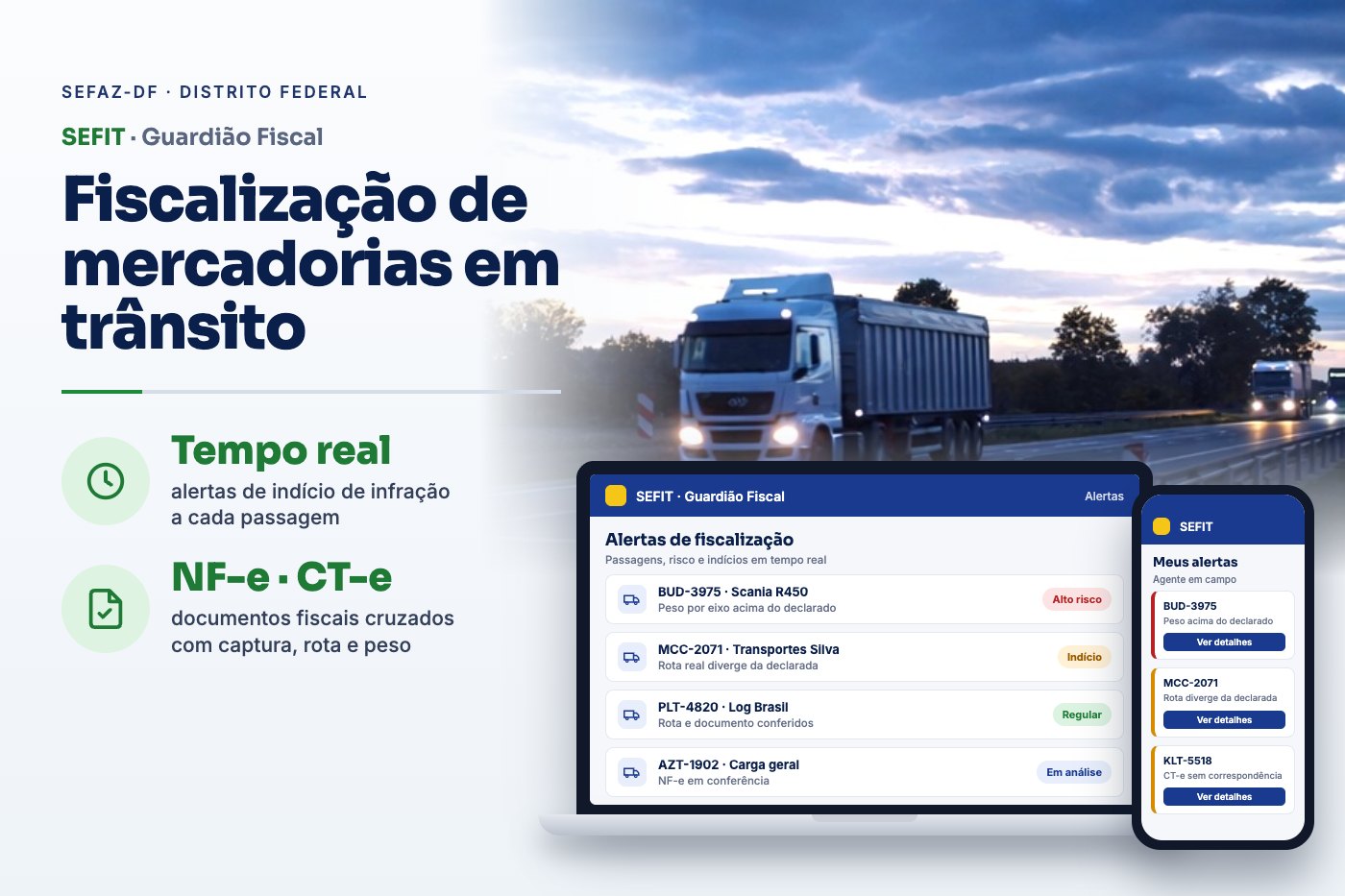
Selective inspection: agents approach the vehicles the data cross-check flags as higher risk.
Project context
How inspecting goods in transit in the Federal District stopped depending on random stops and started acting where the tax risk is highest.
Stopping everyone on the road isn't inspection. It's a gamble.
Inspecting goods in transit is one of the fronts the Federal District Department of Finance (SEFAZ-DF) uses against tax evasion. In the traditional approach, the decision to stop a vehicle depends on the instinct of whoever is on the road: it holds up the compliant, burns the agent's time, and lets whoever planned the irregularity through.
SEFIT, the Electronic Tax Inspection System, brought Analytics and Big Data to this operation. Developed by Central IT with partners DataTraffic and FiscalTech and sold as CITSmart Guardião Fiscal, it cross-checks each vehicle's capture against weighing, route and electronic tax documents, and flags, in real time, which passages show signs of infraction.
About the project
The agency, the operation served, and what makes up the solution.
Location
SEFAZ-DF, inspection of goods in transit, Federal District
Who uses it
Tax auditors, tax inspection agents and the fiscal intelligence unit
Strategic priorities
- Fighting tax evasion
- Selective inspection, guided by evidence
- Tax fairness between compliant and non-compliant payers
Solution focus
- OCR capture and weighing on the road
- Cross-checking against NF-e, CT-e and NFC-e
- Web and mobile applications plus a situation room
- A Big Data base with a history of evidence
Results in numbers
Real time
Infraction alerts
continuous analysis of passages, 24 hours a day.
Selective
Risk-based inspection
agents approach the vehicles with the highest probability of irregularity.
NF-e · CT-e
Tax cross-check
electronic documents checked against the capture, route and weight.
Web and mobile
Integrated view
from the agent in the field to the situation room, on the same data base.
Strategic points
Challenges
SEFAZ-DF needed to inspect the flow of goods entering and moving through the Federal District without relying on random stops. Stopping vehicles at random is expensive in staff time and idle hours, inconveniences regular carriers, and rarely reaches whoever organized the tax evasion.
What was missing was a link between what happens on the road and what's declared in the tax documents. Without cross-checking plate, weight, route and invoice, discrepancies such as undeclared cargo, transshipment, a route different from the one declared, or a cloned plate went unrecorded, and enforcement depended on catching the act red-handed.
Solution
SEFIT registers every vehicle in transit with capture and OCR equipment: plate, color, make, model, speed, dimensions and weight. The tax rules registered in the system cross-check those passages against the electronic tax documents (NF-e, CT-e and NFC-e).
When the cross-check finds a discrepancy in route, weight or document, or identifies a stolen vehicle or a cloned plate, the system generates an infraction-indicator alert. The alerts reach the web application, the field agent's mobile app and the situation room, which follows the operation in real time.
Every passage is stored in a Big Data base, which consolidates the history of routes, weighings and documents. That history is what supports the analysis of transport patterns and gives inspectors consistent evidence to back up enforcement.
Measurable delivery
Results and impact on inspection
What changes in the inspection operation when the approach becomes data-driven.
Results
Infraction-indicator alerts generated in real time, with continuous analysis of passages.
Discrepancies in route, weight and tax documents detected by cross-checking, not by catching the act red-handed.
Identification of stolen vehicles, cloned plates and cargo outside the declared pattern.
Field agents, the situation room and fiscal intelligence working on the same data base.
A consolidated history of evidence to back up tax enforcement.
Impact
With SEFIT, inspecting goods in transit in the Federal District started acting where the tax risk is highest. Compliant carriers continue on their way, inspection effort concentrates on the signs of infraction, and those who follow the law no longer compete at a disadvantage against those who evade it.
Because this is our business: empowering people. Impacting organizations.
The case on video
See SEFIT in real-world inspection.

Talk to a Central IT specialist
See how Guardião Fiscal applies to inspecting goods in your state. Our team helps design the path, from capture points to the situation room.