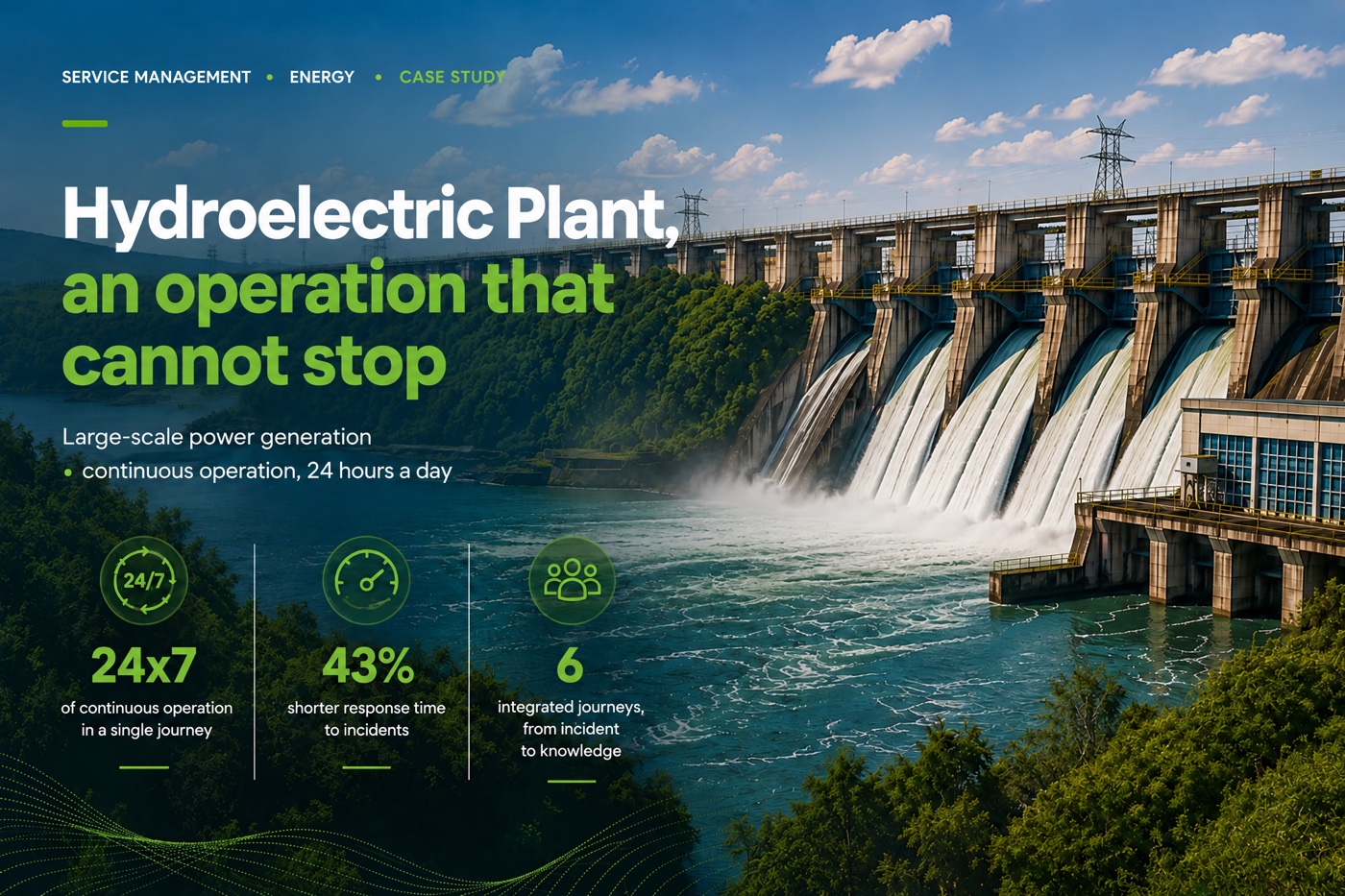
Response time to occurrences 43% lower, with structured classification and escalation criteria.
Project context
What this operation is, which assets it keeps running and what an incident required before the equipment came back online.
Here service management did not come to fix. It came to preserve.
A large electricity generation company runs critical infrastructure: generating units, electrical systems, electromechanical equipment, control, automation, protection and telecommunications. What it delivers, in practice, is energy availability, 24 hours a day, without interruption.
The operation already had a high level of technical maturity, safety and availability, and that was the project's starting point. Working with Central IT, service management came in to preserve that excellence in an increasingly complex environment, connecting occurrence, asset, intervention, change and knowledge into one journey.
About the operation
Company not identified. The figures describe the size and profile of the operation.
Sector
Large-scale electricity generation
Regime
Continuous operation, 24 hours a day, seven days a week
Assets
Turbines, generators, transformers, automation and protection
Areas involved
Operations, maintenance, engineering, automation, procurement
Solution focus
- Occurrence tied to the asset, the cause and the intervention
- Change with impact analysis, risk and window
- Technical knowledge recorded and reusable
Results in numbers
24x7
Continuity
pending work and risks survive the shift handover.
0%
Response time
lower in handling occurrences.
0%
Recurrence
lower on failures handled as problems.
6 journeys
Integrated
occurrence, incident, problem, maintenance, change and knowledge.
Strategic points
Challenges
An occurrence spotted by Operations could require diagnosis from Engineering, action from Maintenance, systems assessment, spare parts availability, supplier mobilisation and testing before releasing the equipment. Each step had to answer what happened, which asset is involved, how critical it is, whether generation capacity is affected, who owns it and what the deadline is.
Taking a critical asset out of operation requires planning the window, impact, people, materials, documentation, safety and testing. Add a long technology modernisation cycle, with existing equipment coexisting with new technology, and decades of technical knowledge concentrated in the experience of the professionals.
Solution
Central IT structured service management as an orchestration layer over the operation, across six journeys: operational occurrences, critical incidents, problems, integration with maintenance, changes and knowledge. Each event now carries asset, criticality, owner, teams involved, deadlines, escalations, evidence and formal closure.
Problem management began linking occurrence, cause, asset, solution, intervention and prevention, revealing recurring failures and assets with the highest incidence. Changes gained impact analysis, risk assessment, approval, window, testing and validation. And technical knowledge (procedures, known errors, solutions, diagnoses) began being recorded and reused, instead of living only in the experience of whoever was on shift.
Measurable delivery
Results and impact on the operation
What changed once occurrence, asset, maintenance, change and knowledge started relating to each other.
Results
Recurrence 38% lower on failures handled through problem management.
Intervention preparation 29% faster, with materials, window and owners defined upfront.
Operations, maintenance and engineering working inside the same service journey.
Changes to critical systems under a controlled flow of impact, risk, approval and testing.
Every asset now seen alongside its operational history and known causes.
Continuity across shifts: pending work, risks and decisions cross the handover with context.
Supplier interventions tracked within the same operational view.
Impact
The biggest gain was creating a connection between elements that always belonged to the same reality and were tracked separately: occurrence, asset, person, maintenance, problem, change and supplier. In an already mature operation, the value was not in fixing what failed; it was in turning decades of technical experience into a process that is digital, measurable and transferable.
Because this is our business: empowering people. Impacting organizations.

Talk to a Central IT specialist
If your operation is critical, continuous and depends on several specialities acting together, service management connects what is tracked separately today. Our team helps design the path.