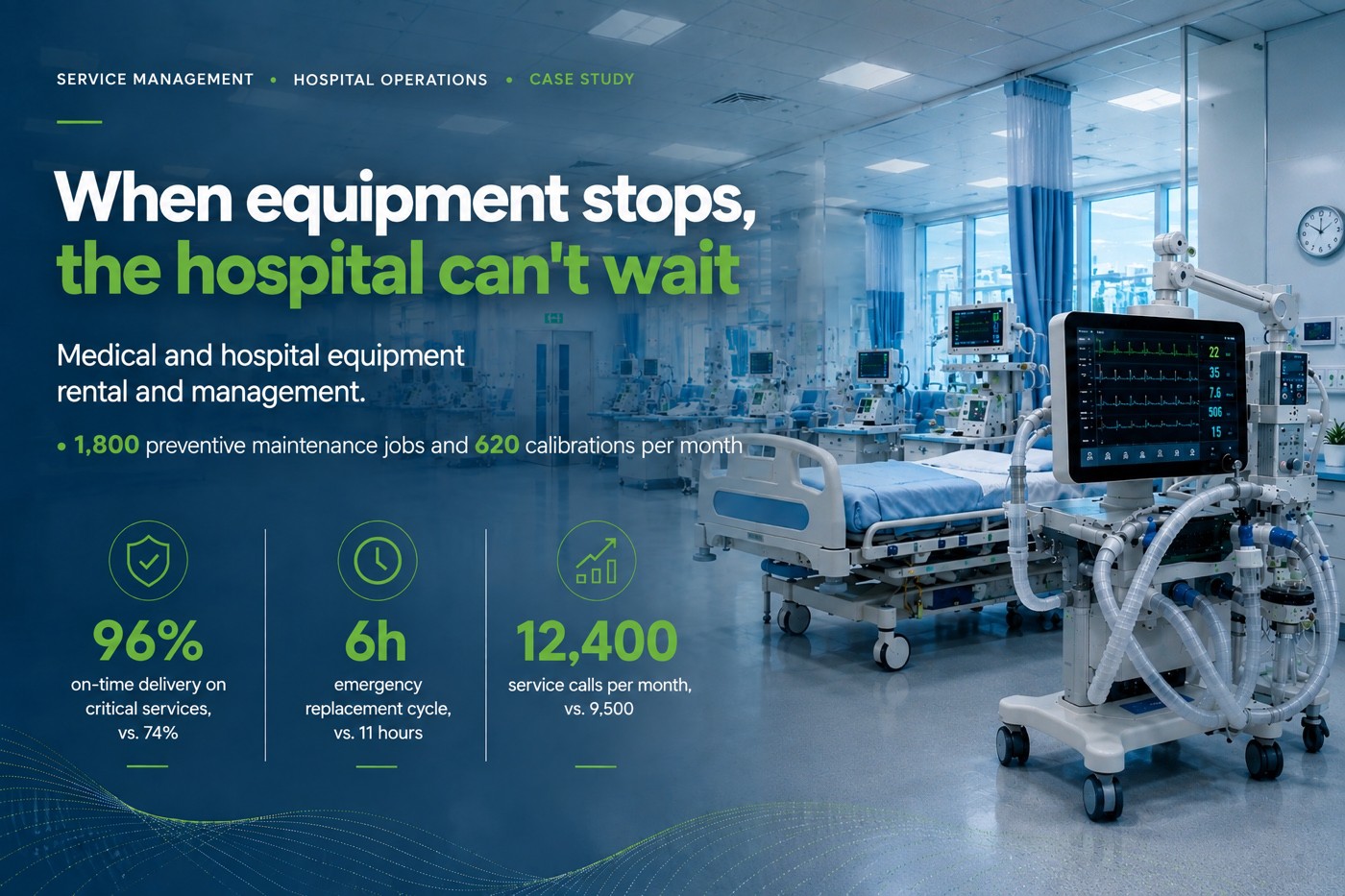
96% on-time delivery on critical services, against 74% before.
Project context
What this operation is, which hospitals it serves and how its teams coordinated on every equipment call.
Every ticket is a device, a contract and a deadline.
A medical equipment rental and management company serves hospitals, clinics and healthcare units across several regions. Technical sales, clinical engineering, logistics, support, maintenance, quality, contracts and finance all have to act together on each request, and part of the information lived in spreadsheets, emails and separate systems.
Working with Central IT, the operation began treating request, device, contract, deadline and evidence within a single enterprise service journey, with an owner, a status and an indicator at every step.
About the operation
Company not identified. The figures describe the size and profile of the operation.
Sector
Medical equipment rental and management
Clients
Hospitals, clinics and healthcare units across regions
Operation
1,800 preventive maintenances and 620 calibrations a month
Areas involved
Clinical engineering, logistics, support, maintenance, contracts
Solution focus
- Priority driven by device and environment criticality
- History, report and evidence per asset
- Response deadlines tracked by contract
Results in numbers
0%
On-time delivery
on critical services, against 74% before.
0%
Critical incidents
faster resolution: from 5h36 to 3h18.
0%
Emergency swap
faster: the cycle fell from 11 to 6 hours.
12,400
Tickets/month
against 9,500, with no proportional headcount increase.
Strategic points
Challenges
In an ICU, an operating room or an emergency department, a slow response to stopped equipment compromises patient care. The company needed to separate the critical from the scheduled: a ventilator in an ICU cannot share a queue with a hospital bed under planned maintenance.
Volume made it harder: 1,800 preventive maintenances and 620 calibrations a month, each requiring a schedule, an owner, a report and proof. Requests arrived through different channels, areas worked with their own controls, and answering where the device is, which contract applies and whether the deadline is being met meant searching in several places.
Solution
Central IT structured the operation on ESM, enterprise service management, connecting request, device, contract, deadline and evidence into a single journey. A service catalogue, service portal, queues, priority rules by criticality, deadlines by contract type, alerts and escalations were put in place.
Every asset gained its own history: location, status, contract, maintenances, calibrations and past tickets. The preventive schedule now has an owner and attached evidence, and the emergency swap became a flow with approval, picking, dispatch and confirmation, instead of a race by phone.
Measurable delivery
Results and impact on the operation
What changed once request, device, contract and deadline started living in the same journey.
Results
Average technical response time 34% lower: from 9h48 to 6h30.
Critical incidents resolved 41% faster: from 5h36 to 3h18.
Emergency swap cycle 46% shorter: from 11 to 6 hours.
Delays in preventive maintenance reduced by 52%.
Calibrations with complete documentation in the asset history: from 62% to 89%.
Volume handled 31% higher: from 9,500 to 12,400 tickets a month.
Rework between areas 37% lower, and an 18% reduction in travel and misrouted service costs.
Impact
The bigger gain is not any single indicator, but what the operation can now answer on the spot: which device is involved, where it is, which contract applies, who owns it, what the deadline is and what has already been done. In an operation where hospitals are waiting on the other end, that answer is the service.
Because this is our business: empowering people. Impacting organizations.

Talk to a Central IT specialist
If your company handles many clients, devices, contracts and critical deadlines, management has to keep up with that complexity. Our team helps design the path, from diagnosis to operation.