
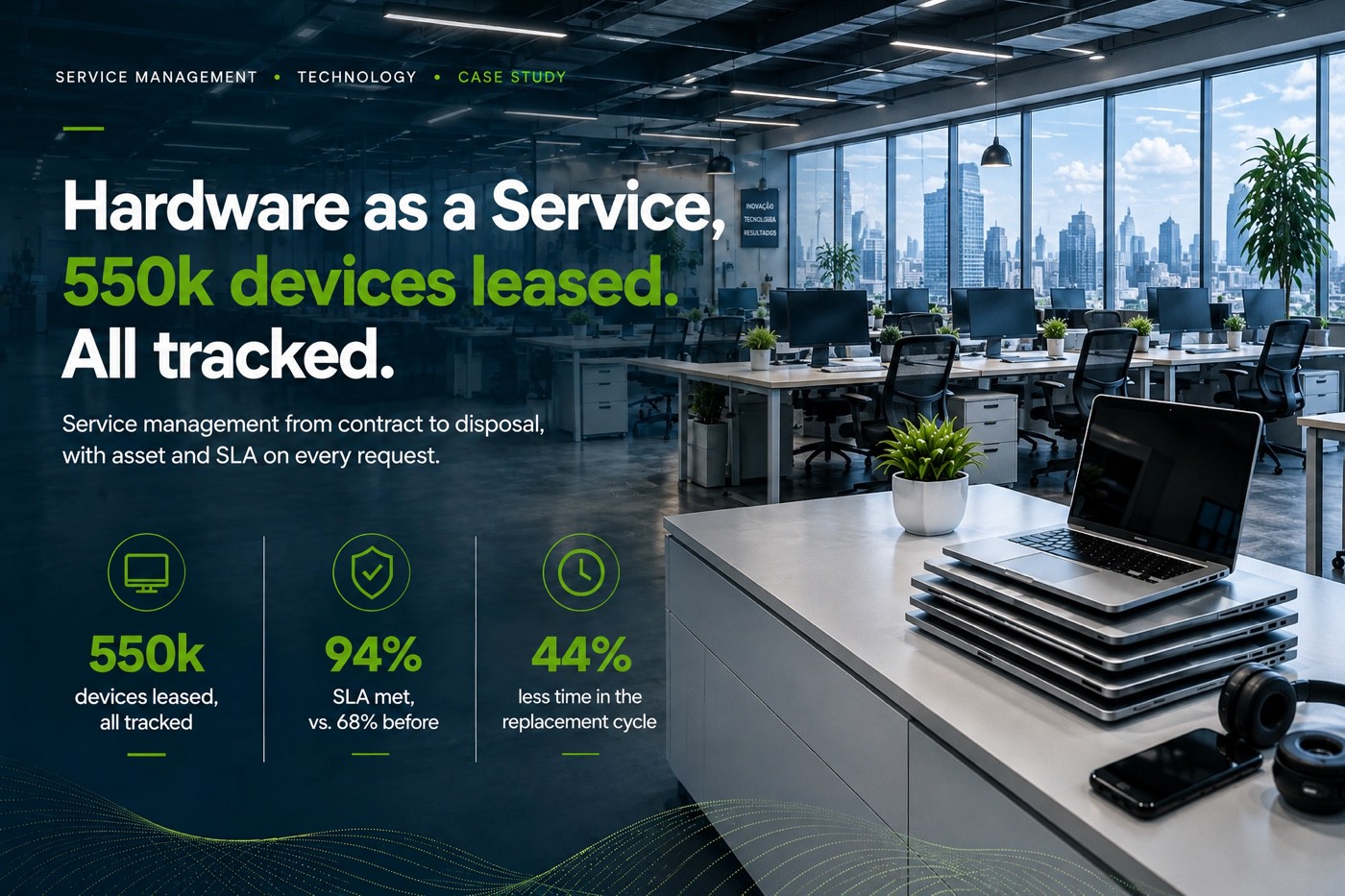
550,000 devices under management, each with history, contract and tickets linked.
Project context
The Hardware as a Service operation, the size of its installed base and how each request moved through sales, logistics and support.
From contract to disposal, everything is a service journey.
A leading Brazilian Hardware as a Service company keeps 550,000 devices on rent across thousands of clients: laptops, desktops, tablets, smartphones and servers. The model combines technology, support, logistics, asset management and circular economy, with refurbished sales, trade-in, reverse logistics and sustainable disposal.
Sales, logistics, technical support, field service, inventory, maintenance, contracts, finance and compliance all had to act in coordination. Working with Central IT, the operation began treating each request as a managed service, tied to the asset, the contract and the SLA.
About the operation
Company not identified. The figures describe the size and profile of the operation.
Sector
IT infrastructure as a service, HaaS model
Installed base
550,000 devices on rent
Operation
Delivery, support, swap, pickup, data wiping and disposal
Areas involved
Sales, logistics, field service, inventory, contracts
Solution focus
- Asset, contract and SLA tied to every request
- Standard flows for delivery, swap and reverse logistics
- Evidence and checklist on data wiping
Results in numbers
550k
Devices
under management, with history and contract linked.
0%
SLA compliance
against 68% in the previous scenario.
0%
Swap cycle
shorter between request and replacement.
0%
Rework
lower across sales, logistics and support.
Strategic points
Challenges
The problem was not lack of effort from the teams: it was scale. With devices spread across thousands of clients, every request needed a clear entry channel, an owner, a deadline, a priority, a history, evidence and a connection to contract, asset and SLA, and part of that lived in spreadsheets, emails, messages and parallel controls.
That produced loss of visibility over progress, difficulty locating assets, delays in swaps, deliveries and pickups, rework between areas, and little predictability for clients. Growing in that shape meant growing while losing control.
Solution
Central IT structured the operation on ESM, connecting areas, flows, requests, assets, contracts, SLAs and indicators. A service catalogue, service portal, queues, priority rules, SLAs by service type, alerts, escalations and automation of operational steps were put in place.
The journey came to cover the full cycle: contracting, delivery, installation, support, swap, maintenance, pickup, data wiping, disposal and renewal. Each device gained a history with location, status, contract and past tickets, and data wiping began recording checklist and evidence, a compliance and data-protection requirement that used to depend on manual control.
Measurable delivery
Results and impact on the operation
What changed once request, asset, contract and SLA started living in the same journey.
Results
94% SLA compliance, against 68% in the previous scenario.
Device swap cycle 44% shorter between request and replacement.
Rework between areas 38% lower, with a defined flow and owner per service type.
Average response time 32% lower.
Request backlog 30% lower, prioritised by SLA and criticality.
24% productivity gain, with the same structure absorbing more volume.
Data wiping and disposal recorded with checklist and evidence per device.
Impact
A Hardware as a Service company does not sell equipment: it delivers technological availability. And when clients depend on that availability to work, sell and serve, every step of the journey has to function. The gain was turning an operation that grew fragmented into a journey that is controlled, measured and ready to grow further.
Because this is our business: empowering people. Impacting organizations.

Talk to a Central IT specialist
If your company delivers service at scale, with assets, contracts and SLAs spread around, management has to keep up. Our team helps design the path, from diagnosis to operation.