
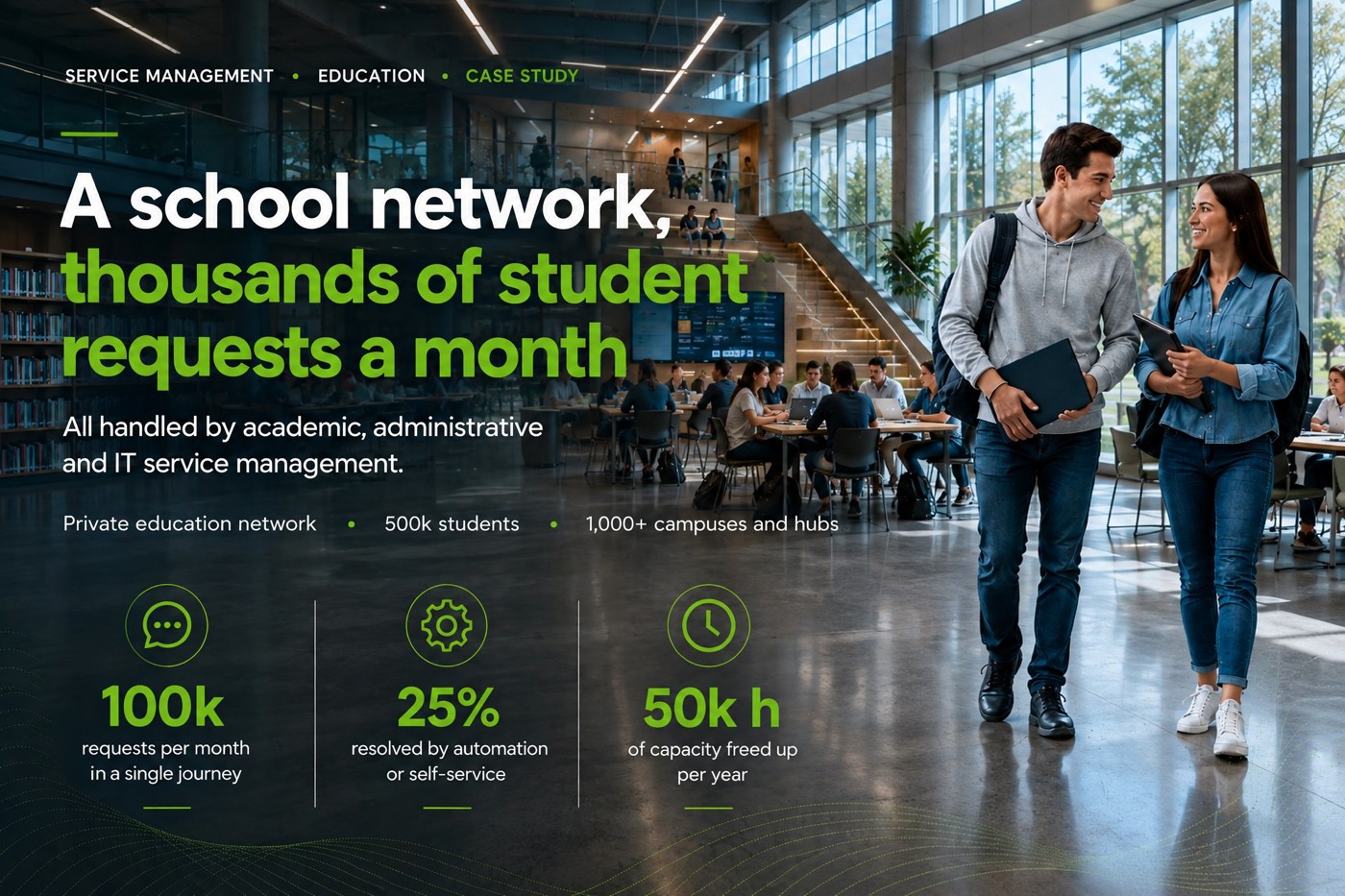
100,000 monthly requests managed within a single journey.
Project context
The size of the network, how many students it serves and how a request traveled between registrar, coordination and finance.
Students do not care which department solves it. They want the answer.
One of the largest private education networks in the country combines on-campus and digital learning, with 500,000 active students, more than 1,000 campuses and hubs and hundreds of programmes. Support, registrar, coordination, finance, IT, library, internships and hub management already delivered services; the problem showed up when a request had to cross two or more of those structures.
With around 100,000 requests a month, small inefficiencies scaled fast. Working with Central IT, the network started treating every request as an end-to-end managed service, with an owner, a deadline and a history.
About the institution
Institution not identified. The figures describe the size and profile of the operation.
Sector
Private education, on-campus and digital
Students
500,000 active students
Operation
More than 1,000 campuses and hubs, hundreds of programmes
Volume
Around 100,000 requests a month
Solution focus
- Catalogue of academic, administrative and IT services
- Automation and self-service for repetitive demand
- Dashboards for volume, deadline and bottleneck by area
Results in numbers
0k
Requests/month
managed within a single journey.
0%
No human queue
resolved by automation or self-service.
0%
Resolution time
lower between opening and conclusion.
50k h
Capacity released
per year, redirected to what needs people.
Strategic points
Challenges
At 100,000 requests a month and roughly 18 minutes of average handling, the operation could consume 30,000 working hours per month. A relevant share of that volume was repetitive: duplicate documents, access problems, academic information, financial questions, enrolment guidance.
At the same time, complex demands required specialised human analysis, and competed for the same queue. Requests arrived through different channels, making a single view of the student's history hard, and those depending on more than one area accumulated handoffs until resolution.
Solution
Central IT built an ESM layer over the education operation, looking at the student journey rather than the isolated ticket. A service catalogue, service portal, standardised flows, classification rules, owners, service levels, deadline alerts, escalations and a knowledge base were put in place.
Volume analysis revealed patterns: simple requests began being resolved directly by automation and self-service, and others classified and routed automatically. When another area had to take part, the request stayed inside the same journey, with the student following its progress.
Measurable delivery
Results and impact on the operation
What changed once support stopped being a loose contact and became a managed service.
Results
Average handling time 30% lower: from 18 to around 12.5 minutes.
Average resolution time 35% lower between opening and conclusion.
25% of requests resolved by automation or self-service, around 300,000 a year.
Unnecessary handoffs between areas reduced by 40%.
Operational backlog 28% lower, with better prioritisation of pending work.
20% estimated productivity gain, with the same structure absorbing more volume.
More than 50,000 hours of capacity released per year for work that needs human analysis.
Impact
The result that changed the institution was not the indicator, but the reading it enabled. When thousands of students open requests about the same topic, there is information behind that: a message to simplify, a process to fix, a service to redesign. Support became a source of intelligence about the educational journey itself.
Because this is our business: empowering people. Impacting organizations.

Talk to a Central IT specialist
If your institution serves thousands of students across many channels and areas, service management has to match that scale. Our team helps design the path, from diagnosis to operation.