
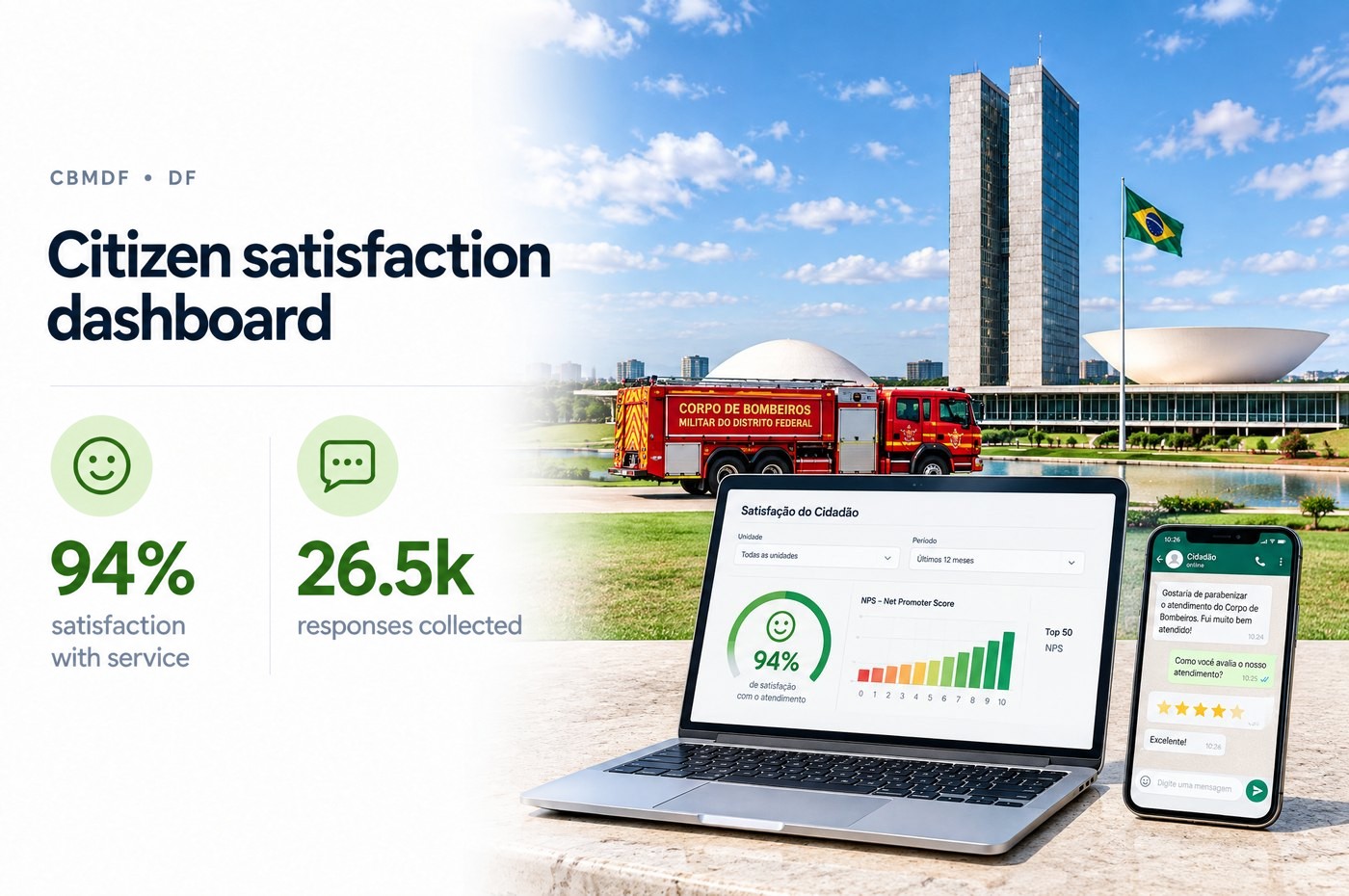
26,500 responses collected in just over a year of the survey.
Project context
What the Federal District Fire Department handles every year, how the perception of people who were rescued started being measured, and what the dashboard opened up to citizens.
The opinion of people who were rescued, measured call by call.
The Federal District Military Fire Department handled more than 173,000 operational calls in 2025, plus 40,915 preventive operations and 10,650 inspections. Since April 2024, right after every call dispatched through 193, the person who was served receives an invitation over WhatsApp to rate the service.
In partnership with Central IT, the corps turned those responses into the Citizen Satisfaction Dashboard, launched in October 2025: an interactive platform that opens the public's perception of its own service to the population and hands every commander their unit's indicator. In just over a year there were 26,500 responses, with 94% satisfaction and 92% trust.
About CBMDF
Data on the operation and the reach of the satisfaction survey.
Location
Federal District Military Fire Department, Brazil
2025 operation
173,684 operational calls, 40,915 preventive operations and 10,650 inspections
Survey reach
26,500 responses in just over a year, with about 40% participation
Strategic priorities
- Active transparency and social oversight
- Evidence-based management, not perception
- Continuous improvement of emergency response
Solution focus
- Survey triggered over WhatsApp after every 193 call
- Interactive dashboard by unit, call type and period
- Satisfaction, trust and NPS indicators tracked over time
Results in numbers
0%
Citizen satisfaction
among those served, above the level recorded in 2024.
0%
Institutional trust
declared by people who went through the service, above the national average.
26.5K
Responses collected
in just over a year, with about 40% participation.
Top 50
NPS level
equivalent to the country's 50 largest brands in loyalty and recommendation.
Strategic points
Challenges
An emergency corps measures operations well: calls handled, response time, inspections, preventive operations. There were 173,684 operational calls in 2025. What those numbers don't say is what the person who was rescued thought of the service they received, and without that, service quality turns into perception, not evidence.
The feedback that existed came through traditional ombudsman channels, which mostly capture the extremes and don't allow comparing one unit against another, one type of call against another, one month against the last. What was missing was a channel that reached the average citizen right after being rescued, at a scale matching the volume of the operation, and that returned that data, organized, to whoever commands each unit.
Solution
The survey happens where the citizen already is. Since April 2024, shortly after every call dispatched through 193, the person who was served receives an invitation over WhatsApp to rate the service. The format explains the response rate: about 40% participation, a high number for an unprompted survey, and 26,500 responses accumulated in just over a year.
In partnership with Central IT, those responses became the Citizen Satisfaction Dashboard, launched in October 2025 at the Military Fire Academy auditorium. The dashboard consolidates satisfaction, trust and NPS, and opens the breakdown by operational unit, by call type and by period, including comparing the 193 phone service against in-person service by the crews.
The result doesn't stay at the top. Each commander follows their own unit's indicator and uses the historical series to plan continuous improvement, with the evidence in hand. And because the dashboard is public, the same information that guides the internal decision stays available to the population that funds the service.
Measurable delivery
Results and impact on the operation
What the corps started seeing after every 193 call began generating a citizen response.
Results
About 40% participation among citizens invited to rate the service.
94% satisfaction with the service, above the level recorded in 2024.
92% institutional trust declared by those who were served.
NPS at the level of the country's 50 largest brands, an indicator of loyalty and recommendation.
Indicator broken down by operational unit, call type and period, comparing 193 and in-person service.
A dashboard open to the public, turning the assessment into active transparency and social oversight.
An honorable mention at the Ipê Innovation and Transparency Award, in November 2025.
Impact
The gain is in the conversion: each of the 173,684 calls in 2025 stopped ending when the ticket closed and became information that can turn into a strategic read on the quality of the rescue provided. For a unit commander, that means knowing where to improve before the problem shows up at the ombudsman. For the citizen, it means seeing publicly what the public said about the service they themselves fund.
A good digital government practice, one that strengthens active transparency, social oversight and data-based management, turning every 193 call into strategic information for improving public service.

Talk to a Central IT specialist
See how a public operation starts measuring the perception of the people it serves, call by call, and returns that data to decision-makers. Our team helps design the path, from diagnosis to operation.